

Teacher recruitment timelines matter because UK schools hire on a fairly fixed calendar. Apply outside that window, and your CV can land in a quiet inbox for months. That’s usually why a promising application seems to vanish into thin air.
Many overseas applicants send off their CV the moment they spot a UK teaching vacancy, without knowing schools tend to advertise in predictable seasonal bursts. And to make things trickier, teacher, teaching assistant, and further education recruitment timelines don’t move together.
So the calendar that works for a classroom teacher role won’t necessarily help you land a further education post or a teaching assistant job. This guide breaks down when vacancies actually open up by role type, then covers the visa timing layer that most advice tends to skip entirely.
When Do UK Teaching Vacancies Actually Open Up?
UK teaching vacancies mostly appear between January and May, ahead of the following school year in September. That’s no accident. Most teacher contracts require staff to hand in their resignation by set dates each term. Those deadlines force schools to advertise replacement roles in a predictable seasonal surge.
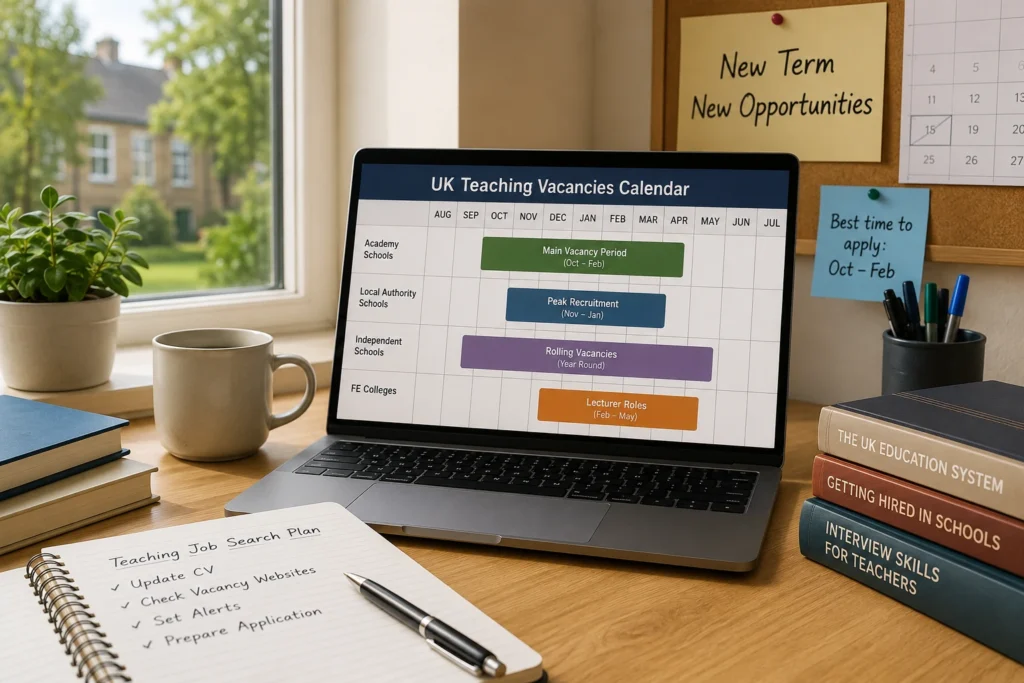
Once resignations come in, headteachers move quickly to fill gaps before the new academic year starts. That’s why February and March tend to feel like the busiest stretch for secondary school vacancies. Interviews often follow within two to four weeks of an advertised role.
Outside of that main window, a smaller autumn hiring wave exists too. Some schools recruit in September through November for roles starting in January, usually to cover staff who’ve left mid-year or new positions created by funding changes. Fewer schools recruit during this stretch, though, so don’t expect anywhere near the same volume of listings as you’d see in spring.
If you’re searching from overseas, the GOV.UK Teaching Vacancies service lets you filter listings by subject, location, and whether a school offers visa sponsorship. That saves you from scrolling through roles you’re not eligible for in the first place.
Why Further Education Jobs and Teaching Assistant Roles Don’t Follow the Same Calendar
Further education jobs and teaching assistant roles don’t follow the same calendar because they respond to different triggers. Colleges hire around course enrolment, while schools hire teaching assistants around pupil need. Neither one waits for September the way classroom teaching does.
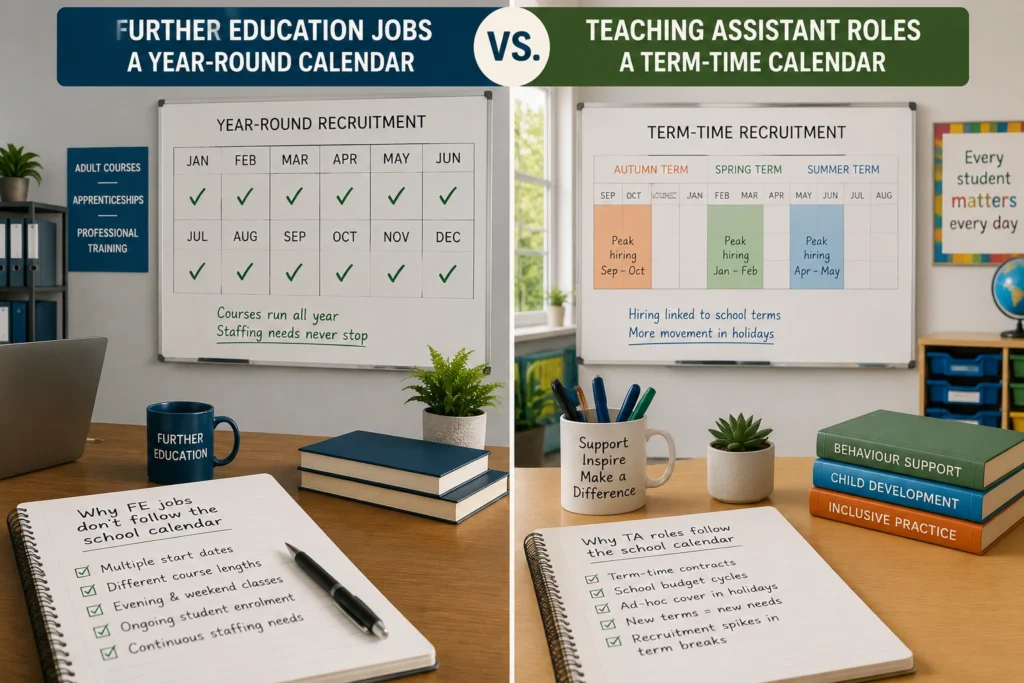
Here’s how those recruitment patterns differ:
- FE Jobs Track Demand: Colleges recruit lecturers whenever a new course launches or enrolment numbers shift, which can happen in November just as easily as June.
- TA Roles Follow Need: Vacancies often appear mid-term with little warning, usually because a pupil’s support plan changes or a SEN caseload grows faster than expected.
- One Timeline Backfires: Apply too late for further education, and you may miss a course-specific window. On the flip side, apply too early for teaching assistant work expecting a spring surge, and you could miss roles that open and close within weeks.
We’ve seen teaching assistant posts advertised in October and filled within days, simply because the school needed cover immediately rather than by term.
If you’re weighing up further education against a support role, check listings on Find a Job alongside subject-specific college boards. To be honest, further education vacancies don’t always turn up in the same places as school teaching posts.
How Visa Timing Changes Your Job Search Strategy
Visa timing changes your job search strategy. After all, landing a job offer at the right time of year means nothing if there isn’t enough runway left to sort your sponsorship. You could apply within the busiest recruitment window and still miss your start date, simply because the paperwork couldn’t catch up in time.
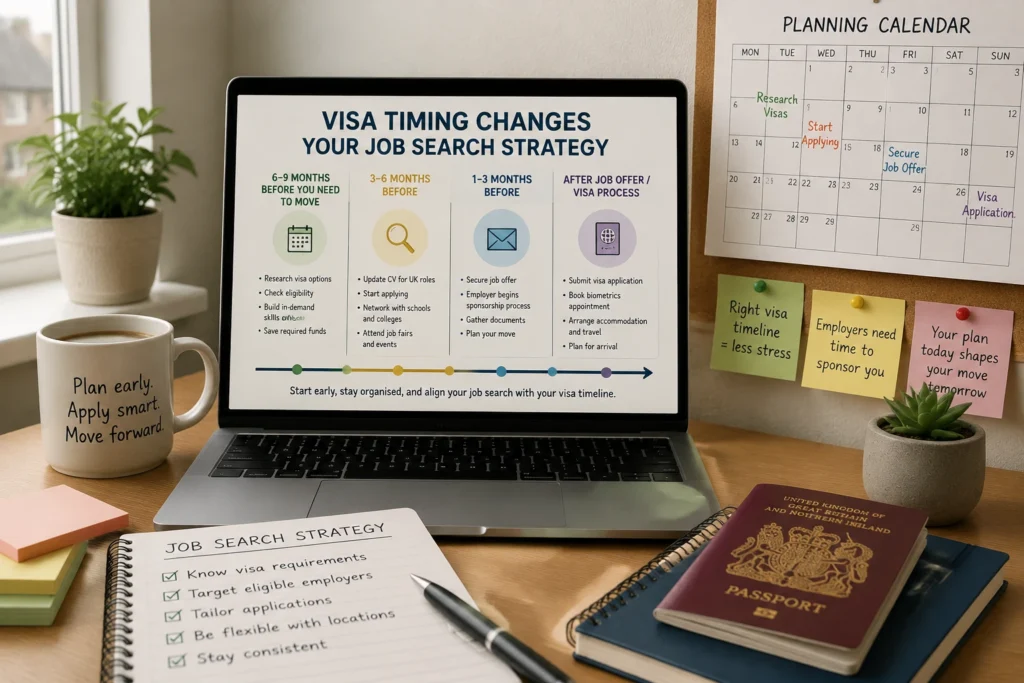
A few things need to line up before you can actually start teaching:
- Licensed Sponsors Only: A school has to hold an active sponsor licence on the Home Office register to issue you a Certificate of Sponsorship, so it’s worth checking this early on.
- Sponsorship Certificate Takes Time: Once a school offers you the job, they still need to assign your Certificate of Sponsorship, which then feeds into your Skilled Worker visa application. This step alone can take a few weeks depending on the school’s internal processes.
- Count Backwards From Start Date: Rather than applying whenever you spot a listing, count Backwards from your intended start date. Build in time for sponsorship, visa processing, and the paperwork that comes with it.
Beyond the Certificate of Sponsorship, you’ll also need to budget for a few more costs. These include the visa application fee, the Immigration Health Surcharge, and proof of funds sitting in your account for a set period before you apply.
We’ve supported plenty of teachers who applied well within the spring hiring window, then found the sponsorship and visa steps ran right up against their September start date. It’s a stressful way to begin a new job. Getting your documents sorted early avoids that scramble entirely.
So it’s worth reading through common application mistakes overseas teachers make before you submit anything.
Your Next Step With UK Teaching Vacancies
Recruitment timing looks different depending on whether you’re applying for a teaching, teaching assistant, or further education role.
Once you understand these separate calendars, planning your job search gets a lot less stressful, and a lot more strategic on your end. Add visa timing into the mix, and it’s clear this isn’t something to figure out alone, especially from overseas.
The Library Fanatic offers ongoing guidance through the requirements and application stages, so you’re not left guessing when to apply or whether your paperwork will be ready in time.
Common Questions About UK Teacher Recruitment Timing
A few questions come up again and again from overseas applicants trying to make sense of the hiring calendar. Here are quick answers to the ones we hear most.
Is there a teacher shortage in the UK in 2026?
Yes. There were around 468,000 full-time equivalent teachers in state schools in England in November 2024. The government has also set a target to increase that workforce by 6,500 by the end of the current parliament. Pupils per teacher have risen too, with the ratio reaching 18.0 in 2024/25.
Around 10% to 15% of newly qualified teachers leave the state sector within their first year. That turnover keeps demand high, particularly in shortage subjects like physics, maths, and modern foreign languages. You can read the full House of Commons Library briefing on teacher recruitment and retention for more detail.
What is the 4-year rule for teachers in the UK?
The 4-year rule allows teachers who trained outside the UK to work in state-maintained schools and non-maintained special schools for up to four years. During that time, they don’t need to hold Qualified Teacher Status.
The rule lasts precisely four years from your first day of teaching in a relevant school, whether or not that work is continuous. After that point, it becomes illegal to keep teaching in these specific school types without QTS.
Is there high demand for teachers in the UK?
Yes, particularly in London, where schools face one of the largest teacher shortages in the country and often rely heavily on supply staff to cover gaps. Demand is highest in STEM subjects and modern foreign languages, where the pool of qualified applicants hasn’t kept pace with vacancies.
What is the 70/30 rule in teaching?
The 70/30 rule is a general teaching guideline, not specific to the UK or to recruitment. It suggests students should be actively engaged for around 70% of a lesson through practice, discussion, or problem-solving. The teacher, meanwhile, talks or lectures for the remaining 30%. It’s more of a classroom delivery principle than anything tied to hiring or visas.
What are the 7 stages of recruitment?
This is a general HR concept (typically covering planning, sourcing, screening, interviewing, selection, offer, and onboarding) rather than a UK teaching-specific process.
School recruitment tends to be simpler in practice: application, shortlisting, interview (often including a lesson observation), and offer. If you need visa support, the Certificate of Sponsorship stage follows after that.