

Unlike most countries, UK school interviews typically involve a full day of assessment rather than a single interview. Rather than focusing on one conversation, schools often combine several stages into a single visit. Each one tests a different part of your teaching approach and how you work with others.
This means preparing only for panel questions won’t be enough. You can answer every question confidently and still be unprepared for a lesson observation or an informal interaction that’s part of the assessment.
Fortunately, once you know what to expect, you can prepare with confidence. This article explains what typically happens during a UK school interview day and how the process differs from formats used elsewhere. It also covers what schools look for at every stage.
Let’s dive in.
UK School Interviews Usually Involve Several Stages in One Day
Picture arriving at 9 am for a teacher interview in the UK. By lunchtime, you’ve taught a class, toured the building, and met a few members of staff, and the formal panel interview hasn’t even started yet.
That’s because UK schools typically assess candidates across several stages in a single day. The exact schedule varies between schools, but a typical interview day includes:
- Lesson Observation: You teach a short lesson to a real class, usually 20 to 30 minutes
- Panel Interview: A formal sit-down with a panel, often including the headteacher
- School Tour: A guided look around the building, sometimes led by pupils
- Informal Interactions: Coffee with staff, a brief chat, or a meeting with the head of department
These stages assess more than your answers in the interview room. Schools are also looking at how you teach, interact, and present yourself throughout the day.
Teaching a Live Lesson Is a Standard Part of UK Interviews
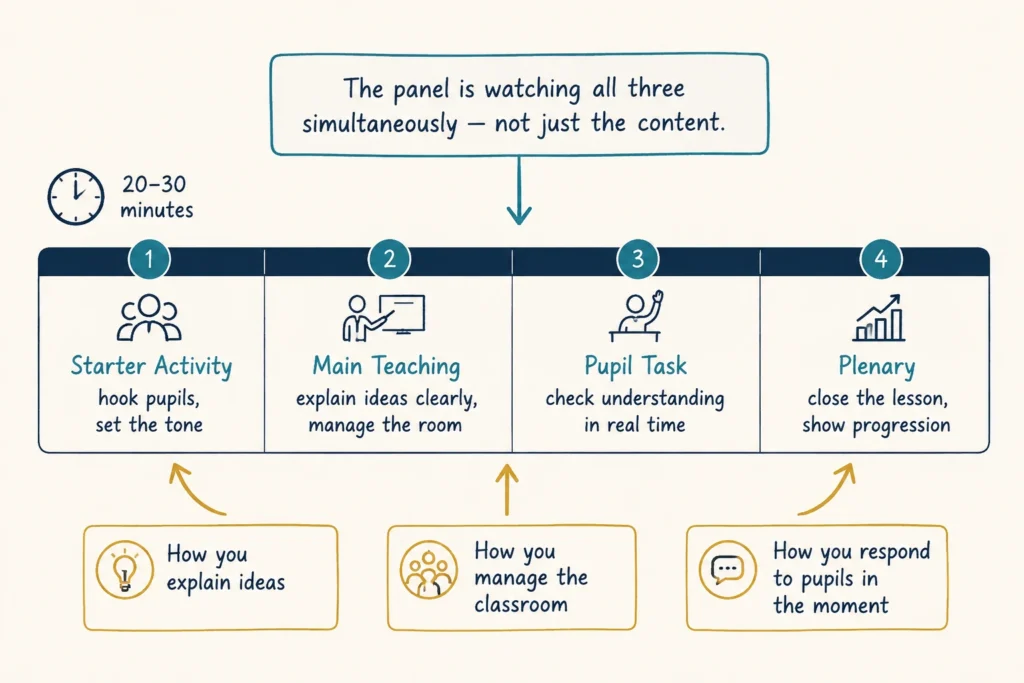
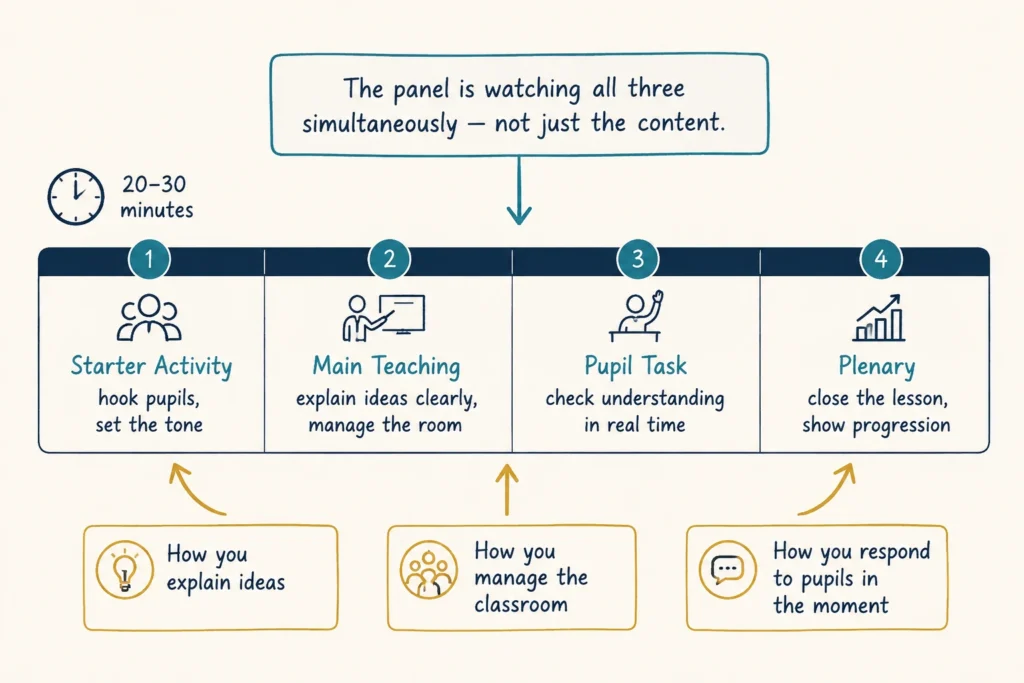
Most UK schools ask you to teach a short lesson to real pupils as part of the interview. It usually runs for 20 to 30 minutes and shows the panel what a conversation alone can’t: how you teach in a real classroom.
You won’t get much time to prepare either. Schools typically share the topic and year group a day or two before, so there’s enough time to plan but not enough to over-rehearse. During the lesson, the panel assesses how you explain ideas, manage the classroom, and respond to pupils in the moment.
That’s a lot to manage at once, especially if lesson observations aren’t standard practice back home.
UK Schools Assess More Than Your Teaching Qualifications
Teaching qualifications and subject knowledge are important, no doubt. But UK schools also assess how you keep children safe and respond to sensitive situations in school.
This responsibility falls under safeguarding, and it comes up in almost every teaching interview. If you can’t speak about it confidently, interviewers will notice, regardless of how qualified you are.
Panels will even explore your understanding of British Values and inclusion. This means knowing what democracy, tolerance, and respect for the law look like inside a classroom. For example, you might encourage pupils to debate different viewpoints respectfully and challenge discriminatory behaviour when it occurs.
UK schools actively promote these values, so they want to hear how you’d apply them in your classroom and within the wider school community.
Interview Questions Focus on Classroom Scenarios
Teaching interview questions in many countries stay fairly general, with questions like “What is your teaching philosophy?” or “How do you handle a difficult class?” In UK schools, the questions get far more specific than that.
Most teaching interview questions here are competency-based. That means interviewers ask you to describe a real situation rather than give a hypothetical response. For example: “Can you give us an example of a time you adapted a lesson for a pupil who was struggling?” Or: “Describe a situation where you had to manage challenging behaviour in the classroom.”
The reason is that panels score each answer against set criteria, so vague responses don’t hold up. They want to hear what you did, the skills you drew on, and the outcome. Surprisingly, experienced teachers sometimes struggle here because they answer in broad terms rather than walking interviewers through a specific moment.
That’s where the STAR (Situation, Task, Action, Result) method becomes useful. It gives your answers a clear structure that UK interviewers recognise and find easy to score.
You’re Being Assessed Even Outside the Interview Room
At some point during the day, a staff member might walk you to a classroom or a pupil might stop to chat in the corridor. It can feel like a breather (it isn’t).
Schools use these moments to see how you naturally interact with students and colleagues outside a formal setting. They get a sense of your communication style, enthusiasm for the school, and how you respond when things don’t follow a script.
Unfortunately, most international teachers we speak to say they only realised this after the day was over. So treat every interaction, including the school tour and a casual conversation with a teaching assistant, as part of the process.
How International Teachers Can Prepare
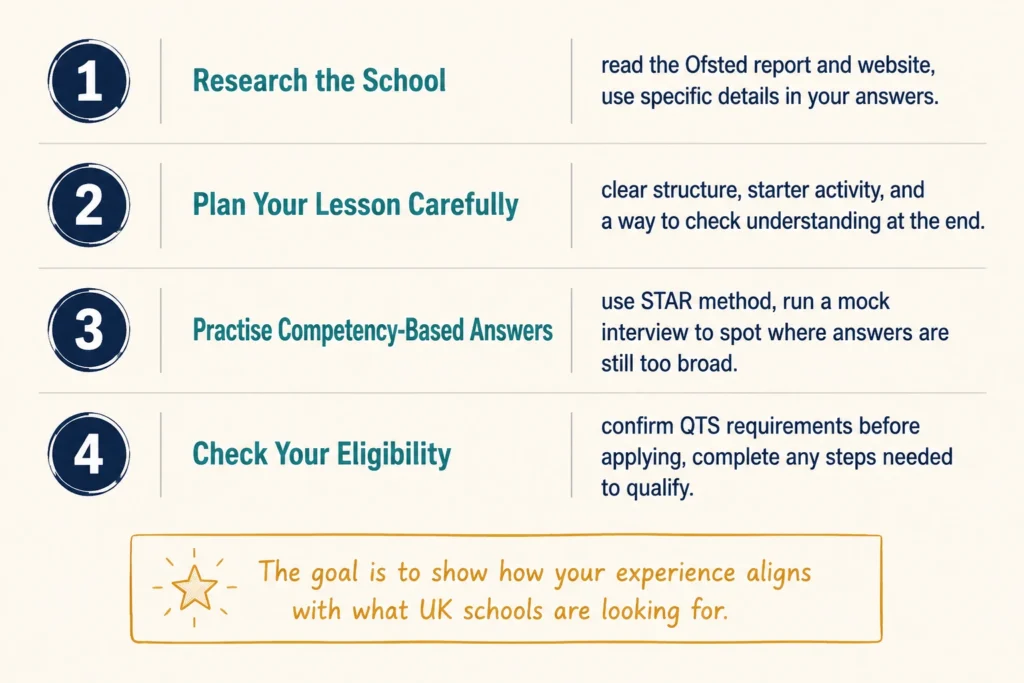
Once you understand the structure of a UK interview, preparing for it becomes far more manageable. A few adjustments can help you feel better prepared and show your strengths more clearly. So before the interview, give attention to these areas:
- Research the School First: Read the school’s Ofsted report and website before your interview. The report highlights the school’s strengths and areas for improvement, while the website gives you a clearer understanding of its community and priorities. Use these insights to include specific details in your answers.
- Prepare Your Lesson Carefully: You should plan your lesson around a clear structure, a starter activity, and a way to check understanding at the end. That way, the panel can follow your thinking and see how you’d run a real classroom.
- Practise Competency-Based Answers: Many interviewers use competency-based questions to assess skills such as leadership, teamwork, problem-solving, and resilience. Practise answering these using the STAR method, then run a mock interview with a colleague to spot where your answers are still too broad.
- Check Your Eligibility: If you’re an international teacher, you’ll usually need Qualified Teacher Status (QTS) to teach in the UK. Before applying for roles, check whether your qualifications are recognised and complete any required steps to make sure you’re eligible.
The goal is to show how your experience aligns with what UK schools are looking for. If you do that well, you give the panel a stronger picture of what you can offer.
The Interview Reflects the System Behind It
A UK school interview looks the way it does because schools here value classroom performance, safeguarding awareness, and genuine involvement in school life. Once you see that, the extra stages start to make sense.
Coming from a different education system simply means preparing a little differently, and that’s something any teacher can do. The Library Fanatic provides guides and resources specifically for overseas teachers making the move to the UK.
Explore our resources to learn more about UK teaching requirements, interviews, and the transition process.